
INTRO
My original purpose with researching 100 first hand accounts of Native American tanning was to find easier, more direct techniques to accomplish that goal: velvet soft buckskin. I knew (or at least hoped, prayed and begged) there would be a way to get wet-scraped hides to brain and soften more easily than what I currently knew. There was! And it has revolutionized the way we and other tanners brain tan deerskins (and resulted in the book Deerskins into Buckskins).
The secondary purpose was to learn how to efficiently tan with only stone-age tools — methods that could be used in a wilderness survival situation. Where better to look, than at the experts?
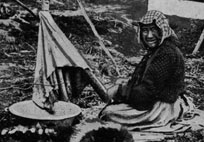
I was highly surprised by many of the other patterns that emerged. There are several common ‘myths’ about Native American tanning and stone tool tanning that simply don’t hold up to any scrutiny. For instance, the idea that ‘white buckskin was only used ceremonially’. The written record clearly shows that many tribes never smoked any of their hides and most only smoked hides for particular uses!
It is also important to point out that not only did different tribes use different tools and methods, but so even did different people within different tribes! The plethora of different techniques, tools and substances used in the process boggles the brain (ever tried using mashed Saguaro cactus seeds instead of brains?). In modern days, we often say there are as many techniques as there are tanners, and the same seems true of the past. Despite this, there are many definite patterns that we can learn from.
One of the challenges of researching tanning on the Plains is the obsession early anthropologists had with buffalo hide tanning. There is typically a long description of this process and then a cursory mention of deer if any at all. The result has been the assumption that deer and buffalo were tanned the same way, which is not at all true! One advantage that an experienced tanner has over an anthropologist, is that we understand a lot more about the practical side of tanning. You read some of these reports and laugh at the conclusions drawn by the anthropologist, things they’d never say, if they had ever brain tanned even one hide…
In this article, I will describe and illustrate most of the recorded approaches to each step in the process. Sometimes a technique is dependant upon other techniques being done or not being done on the very same hide. My purpose here is not to teach you a process, but to show you the many options that were traditionally practiced by Native Americans, and to varying degrees why, so that you may experiment and adopt ones that work for you.
This article will be limited to the dressing of deerskins. Because of their durability, softness and availability, they were the most commonly tanned, worn and utilized skin in North America; the most widely used “fabric” of pre-historic times. While many of these techniques can and were applied to the dressing of other skins (caribou, elk and antelope especially) each skin type has its own structure that requires specialized methods. All information presented here-in is based on the materials I was able to find. There are many tribes for whom I have not been able to find any detailed information (particularly on the east coast). If you know of any reports that would shed a different light on certain details, please contact me.
These deerskin dressing methods will be broken down into subjects in the order of their most common application: beams, fleshing, graining, structure openers, brain solutions, softening, smoking and dyeing.
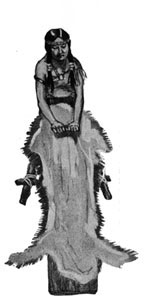
DRY-SCRAPE OR WETSCRAPE?
Almost all stone-age North Americans scraped deerskins wet over a beam. Even on the plains, where dry-scraping was intimately understood for graining (and thus dehairing) buffalo, most peoples chose to wet-scrape deer. However, the reports of deerskin dressing on the northern plains have been greatly obscured by the focus that buffalo tanning received. It is clear that the Blackfeet and Assiniboine dry-scraped some of their deerskins. It is probable that its use extended to other northern plains tribes, at least occasionally, though many of them clearly wet-scraped.
My belief is that dry-scrape was primarily used as a thinning technique on thicker hides to render them lighter weight, easier to brain and soften. This use translated occasionally for some tribes and regularly for a few, to deer. Deerskins are naturally thin, readily softened, and easy to grain wet with primitive tools.
“Beaming tools are thus identified with the dressing of deerskins and in this respect stand distinct from the adze-tool used in dressing buffalo skins. They seem to be used whenever the dressing of deerskins is prevalent.”
Clark Wissler, Plains Indians anthropologist, 1910.
BEAMS
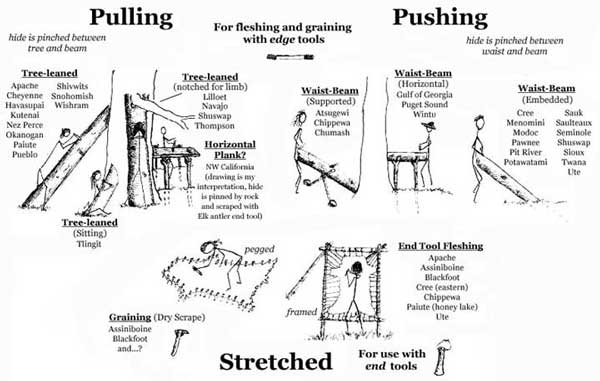
To wetscrape, a solid surface is needed to provide resistance to the tool as layers of skin are pushed or pulled away. Almost always these surfaces took the form of logs leaned against a tree or implanted at an angle in the ground with the other end waist high. Both forms were widespread. Other styles did exist. Horizontal waist-high beams were used in the Gulf of Georgia-Puget Sound area, and horizontal planks were used in NW California.
FLESHING
Depending on how the deer was skinned, fleshing was done before or after graining. If the skin had chunks of meat or fat, it needed to be fleshed first. There were two basic types of fleshing tools, end and edge. For example, with a cannon bone, the end of the bone was cut at an angle and used as an ‘end’ tool. While the side of the cannon bone could be modified and used as an ‘edge’ tool.
Edge tools were used to push or pull the flesh from the skin, which was pinched between a wooden beam and the tool. End tools were used with a chopping motion to remove flesh from skins held under tension in a frame, pegged to the ground or between an object and the other hand. The working edge of the end tool was sometimes serrated to grip the flesh better.
EDGE SCRAPERS– nearly universal, used for fleshing and graining.
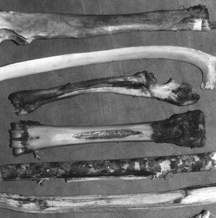
Top to Bottom: Rib, Buffalo (also Deer, Elk, Mtn. Sheep, Moose). This one is actually an extension of a vertebrae from upper rib-cage. Very flat, stout tool, with natural edge. Rib, Buffalo. Ulna-radius, Deer. Natural edge. Don’t over clean, as sinewy membranes hold it together. Use narrower beam. Used in scattered locales. Cannon bone beamer, Elk (also Deer, Mtn. Sheep). Extensive use away from Plains. Two edges created by hollowing out center. Wood and bone scraper. Bone shard implanted in wood with pitch binder. Common to Eastern Woodlands. Great tool. Split stick, Oak. Various hardwoods. Some use on NW Coast and scattered other locales.
Most tribes used the edge tools for fleshing, the same one that they grained with. End tools were used on the northern plains, and filtered into adjacent areas. End tools were extensively used for other types of hides, large ones that were easier to work pegged out, or lashed to a frame, and hides which the hair was to remain on. With hair-on hides, deep fleshing is crucial. This can better be accomplished with end tools because edge tools must be used with a beam, pinching the hide and often damaging the hair. End tools were used throughout North America for this purpose, and are therefore common in the archaelogical record. Deerskins were predominantly fleshed with edge tools on a beam.
END SCRAPERS– some use for Deer, very common for furs and large hides.
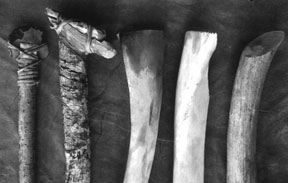
Left to Right: Hafted knapped stone for fleshing. Elbow adze, knapped stone on wood, for fleshing and dry-scraping. Cannon bone flesher, beveled edge, wrist thong brace. Most common of the end scrapers. Serrated cannon bone flesher, less common than previous, gained in popularity after contact. Elk antler, beveled edge, for graining wet-scrape on wooden plank (NW California only). Works, but is it worth the tine?
DEHAIRING/GRAINING
The same edge tools that were used for fleshing were used to remove the hair and grain. Many required but slight modification from their natural form. Tool edges were either squared or beveled. Ribs, cannon-bone beamers, and ulna-radii were the most common. Due to their curved shapes, the ribs and ulna-radii require a narrower crown on the working surface of the beam, so that they don’t contact too large of a skin surface and lose their bite. I’ve scraped several deerskins with their own unmodified ulna-radius, and its been easy, though not as fast as with a cannon-bone beamer. I’ve also been trying out some oak scrapers. So far they’ve been losing their edge too fast, and not gripping the grain enough to push it off. I would like to try some even harder woods like mtn. mahogany, and/or fire hardening the working edge. Amazingly to me, the Yurok reportedly used old douglas fir branches, not even a hard wood. End tools, particularly the adzes, were used for dry-scraping. NW California tribes reportedly used beveled elk antlers to scrape hides, with a wooden plank backing. If this is accurate, this would be a case of an end tool being used to wet-scrape.
STRUCTURE OPENERS
Never heard of this step, huh? This is the really exciting stuff! Fresh hides are structurally bound up by the “ground substance”, a.k.a. mucopolysaccharides ( many sweet mucus?). This is something you need to deal with with every hide you tan! Until recently, most modern wet-scrapers had to brain and rebrain deerskins until they got soft. This can be very annoying. It is necessary because the fibers are coated with “many sweet mucus” that inhibit brain penetration. In living tissue these mucoids prevent penetration by whatever weird stuff you immerse your skin in. Stone-age Indians as well as ancient and modern old world tanners had ways of dealing with this, and did so conciously with each and every hide, and so should you! The bottom line is that if you can neutralize the ground substance, you can get complete brain penetration in one simple dunk in the brain solution.
“…powerful control (is) exerted by the ground substance over the passage of ions through skin. The mucopolysaccharides in ground substance …bind water so firmly that few other types of ions can normally reach the fibres. …Tannage of pelt with the ground substance still present, e.g. the tanning of raw skin, tends to be slow, uneven and uncertain.”
R. Reed, Ancient Skins, Parchments, and Leathers
These are some definite, and some speculative, structure openers that I have found in neolithic deerskin dressing:
* marks the definite ones
*Curing dry skins
*Alkaline soaks (usually wood-ash)
Tannic acid soaks
Carbohydrate soaks (particularly corn)-
Hot springs (opens my structure at least)
*Sharp-tool scraping(dry-scrape)
*Pre-smoking
Repeated freeze/thaw
*Multiple brainings–includes multiple wringings
CURING
“Have you ever noticed that when tanning skins in August, its easy to get the brains penetrated and the hides supple? You think you know what you’re doing… and then you get fresh hides in September and SLAM it takes three brainings to get them soft.”
me
As a dried hide sits over time, it cures. My theory is that the cure involves the mucus bonds weakening and then dissolving. This allows much easier brain penetration. Whether this was conciously used I cannot say, but many peoples had the rhythm of hunting deer in the fall and either fleshing, or fleshing and graining, and then drying and storing their hides until spring or summer. Many tribes had traditions of drying brains and storing them which implies this rhythm. Whether concious or not, this method was and is widely used. In some instances at least, it is likely that the hides were stored in the rafters of dwellings, and were thus pre-smoked (see pre-smoking section) as well as cured.
In my experience, partial cures seem to occur in 4-6 months and full cures seem to require a minimum of 9-12 months, depending on weather and storage conditions. If you find a three year old hide in Aunt Bessie’s barn, tan it! If the bugs haven’t beaten ya too it, it’ll scrape and soften easily.
ALKALINE SOAKS
“The hide of the deer was soaked in water and ashes and the hair removed, and then the process of tanning continued until the buckskin was soft and pliable.”
Geronimo
Many tribes soaked their skins in wood-ash water prior to scraping. The reason for this is often credited to the ashes causing the hair to fall out. The real value of the ashes lies in the alkalinity’s ability to disrupt the mucoid bonds. It opens the structure in two to four days. Michelle and I are excitedly using this method. By adding ash to your pre-scraping soak, you can get complete brain penetration in one simple braining with fresh hides. The Comanche used burnt lime rock for the same effect. It was likely intentionally and unintentionally practiced in desert areas by soaking hides in alkaline lakes, pools or creeks (I now doubt this as few natural bodies of water are alkaline enough to be effective). This method was used, at the very least, throughout the Plains, Great Basin, California, and northern Mexico, as well as scattered other places. This method was also the predominant one used by American pioneers as well as modern commercial tanneries (who use hydrated lime or commercial lye).
Getting the p.h. of the solution right is the key to this method. The ideal alkali content is between p.h. 12 and p.h. 13. Pioneers would float an egg or a potato in the lye solution, if it floated so that an area the size of a quarter was exposed above the surface, then it was perfect. Alkali will temporarily cause hides to swell and feel rubbery. The merit of wood ashes were summed up by Andy Schuebeck, an eighty-four year old rancher that I met this spring, who was reminiscing about his youth when his family and neighbors made buckskin,
“They would soak the hide in wood ash water to get the glue out, so it tanned easier.”
For a complete guide to this method check out the book Deerskins into Buckskins
TANNINS
Prior to braining the Klallam soaked their hides in boiled fern leaves. Other peoples added tannins to their braining solution in the form of shredded wood barks. Lightly tanning hides with tannins allows the brains and other oil dressings to penetrate more easily.
CARBOHYDRATE SOAKS
“Young Indian corn, beaten to a pulp, will effect the same as brains.”
John Lawson , describing the Indians of North Carolina, in 1709.
Indians of the southeast, northeast and the southern plains soaked their hides in corn water. Either using mashed sweet corn alone, or ground flint corn and brains to tan their hides. Soaked corn as it sits quickly sours, with two possible effects. Yeasts (such as acidophilus) digest the carbohydrates in corn and excrete acids … and acids disrupt mucoid bonds. And, if you remember, our friends the mucoids are mucopolysaccharides. The saccharides, are also carbohydrates that the yeasts will digest, opening the structure. I have tried this in part with one hide, and I believe it improved brain penetration. It merits more experiments. There is no evidence that stone-age Indians allowed their corn to sour for this effect. However, mashed sweet corn, soaking for 24 hrs., during corn season on the east coast where it is 90 degrees, 24 hrs. a day, is guaranteed to sour and have these effects. So it must have happened.
The technique of using soured grains was very commonly used in Europe for the same reasons. There they would use, soured grains or even beer dregs.
SHARP TOOLS/DRY-SCRAPE
Using a sharp tool allows one to scrape deeper, removing the entire grain and papillary layer where fibers are densely packed and the ground substance is particularly concentrated. It is easier to penetrate brains into the remaining fiber core where the fibers are larger and less tightly packed. Dry-scrape and sharp-edged wet-scrape(a modern hybrid) both accomplish this, and this is their advantage (see Jim Riggs’ Blue Mountain Buckskin for a thorough account of dry-scraping). They can be very efficient methods, and I have successfully used them many times. The drawback is that you can very easily scrape too deep, creating holes and an uneven surface.
PRE-SMOKING
A few tribes hand-stretched their hides over a smoky fire after the first brain soak prior to the second, and a few others dried their just-scraped hides over a smokey fire. As mentioned before, this may have also been done incidentally by storing hides in smokey rafters. Smoke changes the internal structure of a hide creating crosslinks which I don’t pretend to understand. It is still practiced in Canada by Native Americans on moose hides and by the Dinsmore bros in Montana on deerskins. They say that pre-smoked hides are easily brained in two soaks. For more information read Joe and Victoria Dinsmore’s online guide to ‘pre-smoking’.
FREEZE/THAW
“The Shuswap declare that skins are rendered much easier to dress by freezing (after graining)”
James Teit, ethnographer, 1900.
A few tribes conciously froze and thawed their hides repeatedly, claiming that it made them easier to brain. Matt McMahon and Molly Miller did this for years with the same effect. It is not claimed to result in one soak braining.
BRAIN/REBRAIN
Some tribes, like many of us, simply rebrained their hides once or twice, after working them partly dry, especially large skins. Each time the hide is soaked, brains penetrate deeper, opening the structure more. Repeated wringing and soaking is an efficient form of this practiced by some peoples, then and now. This method is also used when other methods fall short. I tanned 100’s of hides with this general method, and hadalways hoped there was a better way. There is and there are….
Structure openers work. Understanding the need to neutralize the ground substance can make your tanning predictable and fun, instead of unpredictable and irritating. Each of these methods has its ins and outs. I encourage you to experiment and where possible seek out knowledgeable sources for more detailed how-to information.
A suggested control for deerskin experiments
You must know the status of your hide’s internal structure if you want to experiment with ways of improving brain penetration. Use fresh , frozen or wet-salted hides, hides which have not significantly dried since the deer’s death.
When hides dry they start to cure and an unknown factor comes into play: how much is cure affecting your results?
Dried hides don’t fully resaturate easily, which interferes with any soaking experiments you may try (e.g. wood-ash soaks). Hides frozen with the hair-on, or wet-salted seem to undergo no noticeable curing. They are just as tough to brain as fresh ones. Wet-salted means wet, not damp, almost as wet as it was on the deer’s back. I experiment with frozen and wet-salted hides, and use fresh hides for the ultimate test.
Let’s define “A Braining”
As we work to simplify our techniques, hide-tanners often discuss how many brainings it takes to get a hide soft, but we have different definitions of the term. For some, it is how many times a hide was soaked in the brains, for others it is how many times a hide was worked until dry. Each time a hide is brought to the ‘ wrung out sponge’ moisture content and then put in the brain soup, brains penetrate deeper.
I suggest that if you get complete penetration in one soak, call it one braining. If you wring and resoak four times, call it four brainings. If you don’t work the hide dry in between then you are rebraining efficiently, but you are rebraining. (note: hides brain better damp than dry, there is no advantage to working them all the way dry inbetween brainings)
Despite the fact that some techniques can result in consistently complete penetration in just one soak, you’re always better off braining more than once just to be sure.
BRAIN SOLUTIONS
Brains contain emulsified oils, which permeate the water that they are mixed with, rather than seperating from it. This quality allows the tanner to coat the fibers with lubricating oils, without saturating every pour of the skin with oil. Nearly all tribes used brains, although there were a few notable exceptions. Tribes of the southern Colorado River region used saguaro cactus seeds. The Tonto Apache used jajoboa berries, a plant renowned for its emulsified oils. Sometimes, tribes in the southeast used sweetcorn. Peoples from the Gulf of Georgia used fish and sea mammal oils, with a somewhat different methodology. They would completely saturate the skin repeatedly with oils and then they’d degrease it with urine. This would chemically create a different type of leather, known as oil-tan. This is paralleled in modern days, by the tanneries that use cod oil to saturate the skin and then degrease it with sodium carbonate, resulting in what is popularly known as chamois.
Other substances were put directly into the soak solution with the brains. Some of these, added oils; possibly to improve the feel of the finished skin, or at the least, to help the brains go farther. Other additives may have improved penetration by helping the brains slip past or break down the protective mucus.
ADDITIVES TO BRAIN SOLUTIONS:
Oils: spinal fluid, liver, bone marrow, tallows and fats, fish oils, acorn soup, pine nuts.
Soaps: soaproot lather (amole lilly), yucca
Tannins: decayed wood (mostly fir), wild rhubarb, others
Ashes, corn meal
Decomposition: The Sanpoil, Thompson, Wishram and Okanogan purposely decomposed brains for months before using. What this added, besides stench, I do not know, but I imagine something, Would you try this out? and then tell me all about it…
SOFTENING
Buckskin is stretched from damp to dry to make it soft. Tools are used to aid in the stretching, as well as to abrade the surface of the grain and flesh sides. This abrasion of the outer surfaces, allows the skin to stretch fully, and the texture to be soft. Abrading tools were used by all tribes. There were two types, rough surfaced and sharp edged.
The sharp edged tools, because of their shape, also stretch the fibers, serving two functions. Some of these are the “thumb-nail scrapers” common to archaeological sites. Many people mistakenly assume these tools are dry-scrapers.
SOFTENING TOOLS– counter clockwise from upper left:
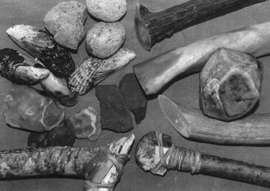
Pumice, great for abrading without overly roughing up surface, extensive distribution. Mussel shells, abrades and stretches. Used as found, convenient thumb slot, and very effective. Common tool on west coast. Simple and retouched flint flakes, and slate shards. Many types of stone used including split river rocks (skipping stone types), extensive distribution. Stone and wood elbow adze, used with frame. Abrades and stretches. Used by buffalo hunting tribes. Hafted knapped stone, abrades and stretches. Plateau, Tlingit, Ojibwa, Natchez. Buffalo humerus core, from bulbous end of bone. It is porous and very abrasive, after aging. Plains. Elk antler, beveled. Abrades and stretches. Plateau, NW California. Cannon bone, beveled. Abrades and stretches. California, Plateau, Apache. Deer antler, beveled. Abrades and stretches. Also, any thing abrasive or with an edge: turtle shells, sandstone, buffalo tongues!
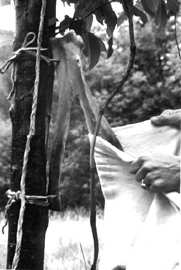
CABLES– left to right: Braided rawhide (buffalo sinew also used). Both mentioned mostly in connection with tanning Buffalo robes. Stretches hide well, a little abrasion, but not very durable (note wear in center). I might try a rawhide thong next time, for same effect, and no time braiding. Buffalo scapula, center of bone removed, working edge beveled sharp. Stretches and abrades, durable. Really shreds! Wild grape vine, lasts longer if used while still living. Some initial abrasion, good stretching. Also, any rough barked woody sapling, vine, or branch. Comanche, Potawatomi, northern California, eastern Great Basin.
Deerskins were very frequently softened in frames (woodlands, plateau, NW Coast), hanging from horizontal poles (plateau, Apache), over beveled posts implanted in the ground, and with the hands and feet. The beveled post was common wherever the frame was not. There were many combinations of tools and softening techniques.
SOFTENING SET-UPS clockwise from lower left:
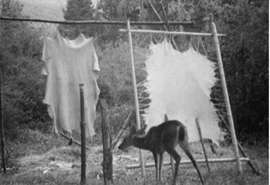
Wooden post with stone implant. This stone has sharp, squared, top edges, so the post abrades as well as stretches. Couer D’Alene, southern California. Wooden post, hide stretched as its pulled over beveled top. Doesn’t really abrade. Very common tool. Suspended hide; hide suspended by buckskin thongs from pole supported by tripods. Allows for easy hand stretching and use of abrading and stretching tools. Plateau, Apache. Frame stretching; frame and hide lashed with rawhide. Allows you to stretch hide larger, thinner and flatter. Also reduces amount of stretch left in finished hide, which is good or bad depending on intended use. NW Coast, Plateau, northern Plains, Woodlands, Southeast. Knapped chert hafted to stick; long for two handed softening. Stretches and abrades. Common with frames. Beveled wood frame softening tool. Stretches, little abrasion.
SMOKING
“…heated smoke; and by some chemical process or other, which I do not understand, the skins thus acquire a quality which enables them, after being ever so many times wet, to dry soft and pliant as they were before, which secret I have never yet seen practised in my own country;”
George Catlin, from his travels on the northern plains, 1832-1839.
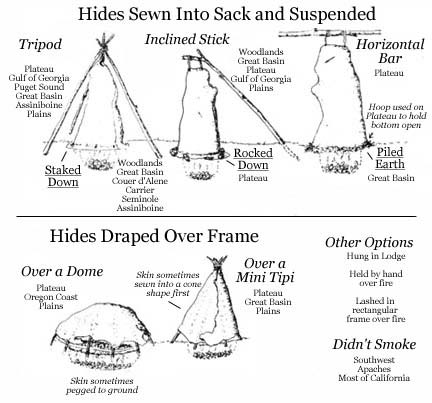
Smoking was not nearly as important as we imagine. Some tribes did it regularly, most did it situationally, and many didn’t smoke ’em at all. Many tribes only smoked moccasins. Next in line was leggings. Others smoked these two items until they were colored, and smoked other hides but not long enough to color them. In drier southern areas (the southwest, Texas, much of California, parts of the great basin) they never smoked their hides. Why not?
The myth is that if white hides get wet they must be completely resoftened. I’ve tested this alot, intentionally and unintentionally. The reality is that when white hides get wet they are somewhat harder to resoften than smoked hides, though not nearly as hard as unworked hides. However, the effects of the brains can be washed out of the hide and the more hides are smoked the easier they are to resoften, especially after multiple wettings. That is why smoking was more important in northern regions and moccasin hides were the most likely recipients.
I think it is also safe to surmise that native people’s buckskin got functionally smoked in their daily lives: hanging up in the lodge, around the campfire, etc. If you’ve ever lived in a tipi or earth lodge or nearly any native dwelling, you’ve no doubt had your clothes smoked a bit too.
TANNIN DYES
“… yellow and red, some black and russet, and every man according to his own fancy.” Spark, one of the explorer De Soto’s companions, describing the deerskin clothing of the Florida Indians.
It is often stated that pre-contact Indians did not know of the use of tannins on hides. This is clearly not true. The very earliest reports, from nearly all sections of this continent, describe the natives coloring their deerskins with various bark dyes. They do not seem to have used them to create a full bark-tan, but even a short soak in tannins will change a hides nature to some degree. Tannins make skins less stretchy and a bit thicker, great for moccasins. They color skins. They may also make them slightly less water absorbant, long soaks do. I do not know how they effect their ability to go from wet to dry repeatedly.
Dyes were specifically used on white unsmoked hides. The art, and range of color were highly developed in the southwest and the southeast. There use was as widespread as smoking, though not always as commonly used. In some areas, tanners clearly had a choice whether to dye, smoke or leave a hide white, depending on the intended use, and the preference of the tanner. Like smoking, dyeing was particularly mentioned in connection with moccasins.
Tannin dyes used: alder, oak, paper birch, douglas fir, canaigre, ferns, sumach, hemlock, ironwood, willow, elm, elder, white maple, mtn. mahogany, indigo bush(dalea emorii), ephedra, lemonade berry (rhus trilobata), oregon grape, honey mesquite, leather root, mistletoe.
PARTING THOUGHTS
“Once the buffalo became virtually extict, and deer and elk scarce, hide preparations and use came to an end, and so abruptly that it has not been possible for scholars to reconstruct in complete detail all of the old ways of dealing with hides.” Thomas E. Mails, referring to the plains cultures.
For the previous generation of brain-tanners, studying old accounts was a hard way to relearn the art of brain-tanning. Thanks to them, we can learn the basics in a week-end class anywhere in the country. And once we have some hands-on experience, the ethnographies, european leather technology, and experimentation, can teach us how to recreate processes that are efficient, authentic, in sync with our bioregion and fun. They may also help us understand how different techniques create different types of buckskin, best suited for specific uses. Whatever its future, brain-tan will forever en-deer you to its sumptuous softness, and primitive strength…
Catlin, George
1913 North American Indians. Leary, Stuart and Co., Philadelphia.
Geronimo
1906 Geronimo: His own Story. Edited by S.M. Barrett. Newly edited by Frederic W. Turner III, E. P. Dutton and Co., New York.
King, Arden Ross
1947 Aboriginal Skin Dressing in Western North America. Unpublished Ph. D. dissertation, University of California, Berkeley.
Lawson, John
1709 A New Voyage To Carolina. Reprinted 1967 by University of North Carolina Press, Chapel Hill.
Mails, Thomas E.
1972 The Mystic Warriors of the Plains. Doubleday and Co., Garden City.
Price, John A.
1962 Washo Economy. Unpublished master’s thesis, University of Utah, Salt Lake City.
Reed, R.
Ancient Skins, Parchments and Leathers.
Swanton, John R.
1946 Indians of the Southeastern United States. Bulletin of the Bureau of American Ethnology, vol. 137, Government Printing Office, Washington D.C..
Teit, James
1900 The Shuswap. Memoirs of the American Museum of Natural History, vol II, pt. VII. G. E. Steckert Publishing, New York.
Wissler, Clark
1910 Material Culture of the Blackfoot Indians. Anthropological Papers of the American Museum of Natural History, vol. V, pt I, New York.